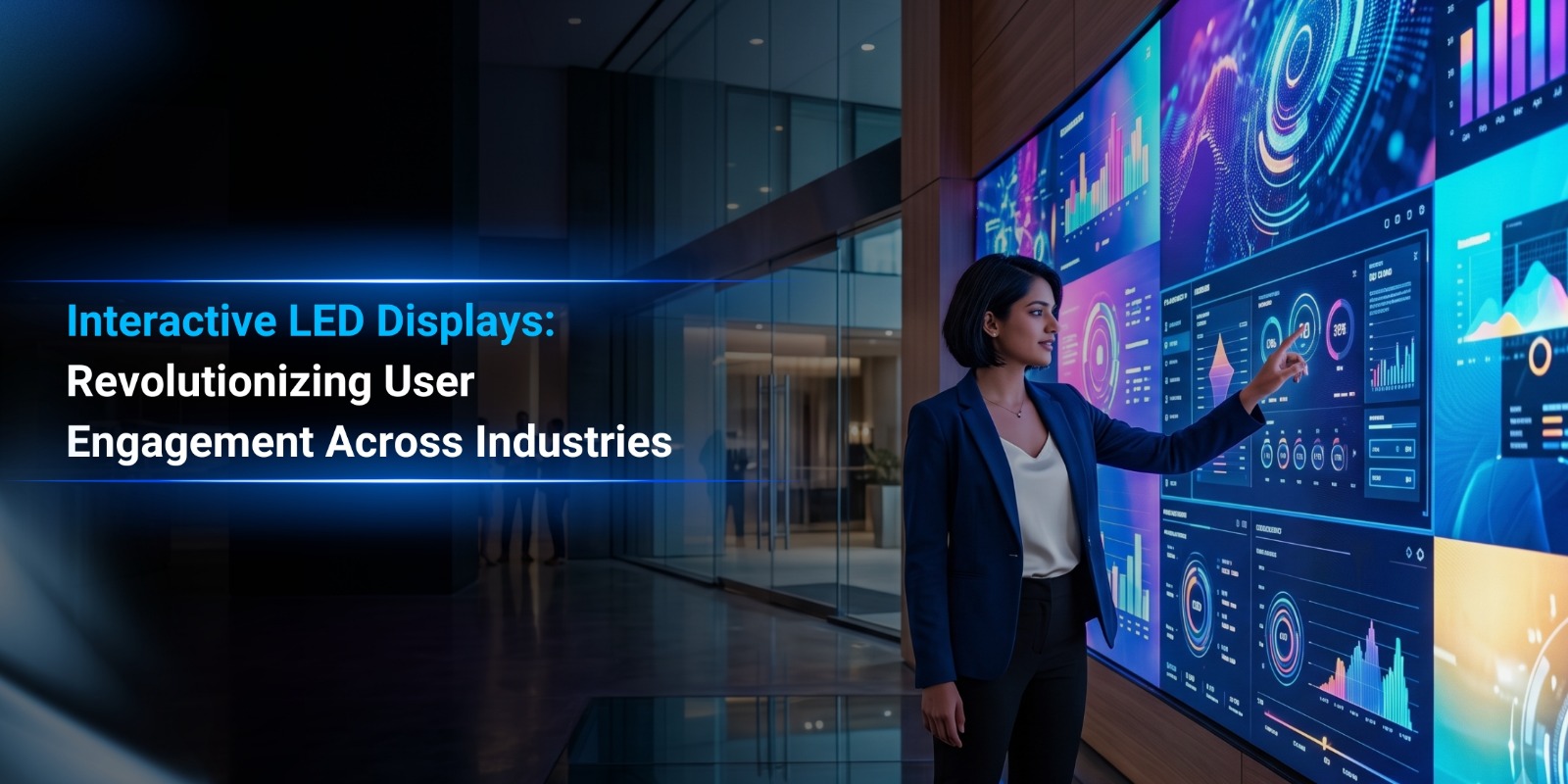
Interactive LED Displays: Revolutionizing User Engagement Across Industries
Digital communication is no longer about putting information on a screen. Increasingly, businesses, schools, merchants, museums, and public spaces are searching for ways to allow audiences to interact with what they are seeing. We think the biggest difference is the shift from passive watching to active participation. When people can explore information, choose material, compare possibilities, or engage with an experience, communication becomes more personal and memorable.
Here, Interactive LED Displays introduce a whole new world of possibilities. They mix huge images with interactive features that enable businesses to transform traditional viewing venues into places for active audience engagement.
Why Interactive Visual Communication Matters?
Every day, people are bombarded with huge volumes of digital information. Just because information is posted doesn’t mean it will be viewed or comprehended. An interactive display modifies this relationship by allowing people to determine how they wish to examine information. A customer can browse products, a student can go through a lesson, and a business team can work with visual material during a meeting. We think this engagement improves communication. Users can interact with information according to their needs rather than just receiving it.
How Interactive LED Technology Improves Engagement
The fundamental distinction between conventional and interactive displays is the degree of user interaction. A traditional screen usually follows a one-way communication strategy where content is made, shown, and consumed. Interactive technology offers yet another level of functionality that enables users to choose alternatives, move between sections, view more information, or interact with visual elements.
This may inspire users to spend more time with the information because they have an incentive to keep investigating. To us, engagement is successful when it goes beyond simply adding technology because it looks amazing. The interaction should make information easy to obtain, interpret, or utilise.
Transforming Retail and Customer Experiences
Visual communication is important in retail situations. Customers often need to find items, evaluate features, comprehend offers, and make judgments quickly.
When Interactive LED Displays are implemented in these environments, buyers can have more influence over the information they wish to see.
A customer might see products, compare specs, see demonstrations, or find comparable items in a way not limited to printed material.
Some practical retail applications include:
- Product discovery: Customers can explore product ranges through digital menus.
- Product comparison: Different models or features can be viewed together.
- Interactive promotions: Offers can be presented through engaging content.
- Brand storytelling: Customers can explore a brand's history and values.
- Store navigation: Digital directories can help visitors find products or departments.
You should always strive to make the consumer journey as easy as possible. If the interaction adds value and doesn’t just add to the complexity, it’s a meaningful part of the shopping experience.
Supporting Education and Collaborative Learning
Interactive technology can also affect the way information is delivered in education. In a typical presentation, pupils are often passive while the teacher controls the topic. Interactive displays may create a more engaging workplace, allowing learners to work directly with visual material such as diagrams, maps, films, quizzes and more.
The bigger visual surface allows the whole class to see the same information. Students can work together on activities, and teachers can customise content according to lesson needs. We believe this makes the display more than just a presenting tool. It can become part of the experience of learning itself.
Making Corporate Collaboration More Effective
Collaboration is the key to today’s workplaces. Meetings might include presentations, video conferencing, dashboards, design reviews, brainstorming, and shared documents. Adding interactive capability to an Advanced LED Display can give teams a wider visual content workspace to work with while sharing the debate.
This might be effective in boardrooms, training rooms, executive briefing areas, and collaborative work locations. Teams may go back through a presentation, highlight critical material, talk about visual data, or drill down into content, all without having to jump between several screens. Thus, the supporting technology should be basic enough that the employees may focus on collaboration and not on the equipment.
Creating Better Museum and Exhibition Experiences
Museums and exhibitions are based on storytelling, but visitors may not necessarily wish to explore knowledge in the same way. Interactive displays can give visitors more control over their experience. You can choose a time, look at a digital map, find out about an object, or get more information about an exhibit. That’s a more individualized journey.
Instead of giving every visitor the same predetermined flow, organizations can allow people to explore the areas that interest them most. This can also help with communicating large volumes of information for displays without overloading the actual surroundings with too much printed content.
Enhancing Events and Brand Activations
Events are more and more participatory for the audience. Conferences, exhibitions, product launches, and brand activations need to offer experiences that people remember. Interactive LED technology can help achieve this goal by enabling visitors to interact directly with digital material.
A product launch could allow visitors to examine product features using an interactive interface. An exhibition may contain interactive maps, and a conference may employ audience involvement to make the sessions more interesting.
Interactive installations can support:
- Product demonstrations
- Interactive brand stories
- Audience participation
- Digital information stations
- Exhibition navigation
- Live event content
- Interactive presentations
The most impactful experiences are those where the interaction has a clear goal.
Designing the Display Around the User
For each interactive exhibit, there are different needs. The final layout is influenced by viewing distance, audience size, content, available space, and interaction techniques.
A retail showroom may need a different setup than a classroom. Similarly, a business meeting room will need a different solution than a major display.
The critical factor for companies evaluating all-in-one displays is the extent to which the integrated system facilitates the desired user experience.
Combining display and control capabilities in some situations might simplify operation, but integration should always be user-centered. A system might be valuable not just because of technological qualities, but also because of ease of use.
Creating Solutions Around Individual Requirements
Each facility has its own requirements for physical setup and operation. A retail showroom display may need to match a particular wall, but a museum may demand an odd layout. Corporate locations may also have specified viewing distances and installation limits.
If normal layouts don’t fulfill these needs, a customised LED Display solution can provide a greater degree of flexibility. Customisation can be related to screen size, layout, design of installation, content needs, or capabilities of interaction. We believe modification should answer a real communication or installation necessity, not just make a system seem different.
Making Interaction Useful Rather Than Complicated
Touch functionality alone does not automatically make for higher engagement. There must be a reason for interaction, and it must be evident. The UI should make it easier for buyers to compare products. The system should support a student who needs to investigate a topic. Visitors should have little difficulty finding information or getting around.
We emphasize this notion, as complex interfaces can actually be harmful to engagement. The simplest are typically the best engaging experiences! Users should grasp what they can accomplish without reading long instructions.
The Growing Role of Interactive Technology
More and more, interactive displays are being networked with software, sensors, content platforms and other digital systems. Future applications can mix large-format images with real-time data, tailored content, gesture-based interaction, mobile connection and data-driven experiences. But we think the opportunity is more than adding more features. It’s about delivering better experiences.
A customer should be able to rapidly find information. A student should be able to work with an idea in a natural way. A visitor should be able to wander through an exhibition with confidence. There shouldn’t be arbitrary technical walls that would prevent a business team from working together. And that’s where the interaction comes in.
Our Approach to Interactive Display Solutions
At UltraLEDdisplays, we think that every interactive display project should start with understanding the audience and the purpose of the installation. We look at the surroundings, viewing distance, content, screen size, interaction needs, installation conditions, and expected usage before we offer a viable strategy.
This application-first strategy guarantees that the technology supports the experience rather than being the experience. A retail installation might be designed to engage the customer, while an educational environment might be designed to promote collaboration. An exhibition can demand immersive narrative, while a business space might require interactive presentations. Every app needs its unique strategy.
Why Interactive Technology Has Long-Term Potential
Interactive LED displays are more than just visual impact at first glance. Content can be updated as campaigns progress, educational materials are developed, products are launched, or organizational needs change. That lets the same display accommodate diverse experiences over time.
Today, a store may utilise it for product discovery and subsequently for promotional activities. A business team can start with presentations and move into collaborative dashboards. We think this flexibility is part of what’s making interactive technology useful across sectors. As communication needs evolve, UltraLED displays focus on producing visual solutions that can evolve with them.
Conclusion
Visual communication is shifting from viewer experiences to participation experiences. Interactive LED Displays combine huge images with interactivity and can help companies create more engaging experiences in retail, education, corporate environments, exhibitions, museums, and events.
The solution that is most effective is not necessarily the one that has the most features. The one where all interaction elements have a clear function. When people are allowed to explore content naturally, communication becomes more personal, more useful, and more memorable.
At UltraLEDdisplays, we always make sure to understand the application, audience, environment, and communication purpose before we build a display solution. We are on a mission to bring large-format digital displays to life so people can actively interact with organizations.
FAQs
1. What are interactive LED Displays utilized for?
They are utilized in retail, education, corporate offices, museums, exhibitions, events, showrooms, and public locations where organizations desire consumers to interact with digital content.
2. How do interactive screens enhance engagement?
Users can explore information, pick content, compare possibilities, traverse information, and participate, rather than watching a fixed message.
3. Do interactive displays work in retail?
Yes, as they’re useful for retailers to help customers find products, compare products, run promotions, communicate brand stories, guide customers, and showcase products.
4. Are interactive displays customizable?
Yes, our organisations can adjust the display size, setup, installation, content, and interaction methods to suit their needs.
5. Are interactive LED displays allowed for businesses to use?
Yes, they can be used by businesses for presentations, collaboration, training, product demos, meetings, visitor experiences, and internal communication.